

Every few weeks a new model tops a leaderboard and the timeline loses its mind.
But if you’ve actually shipped agents in production, you already know the uncomfortable truth: the model is rarely why your agent fails.
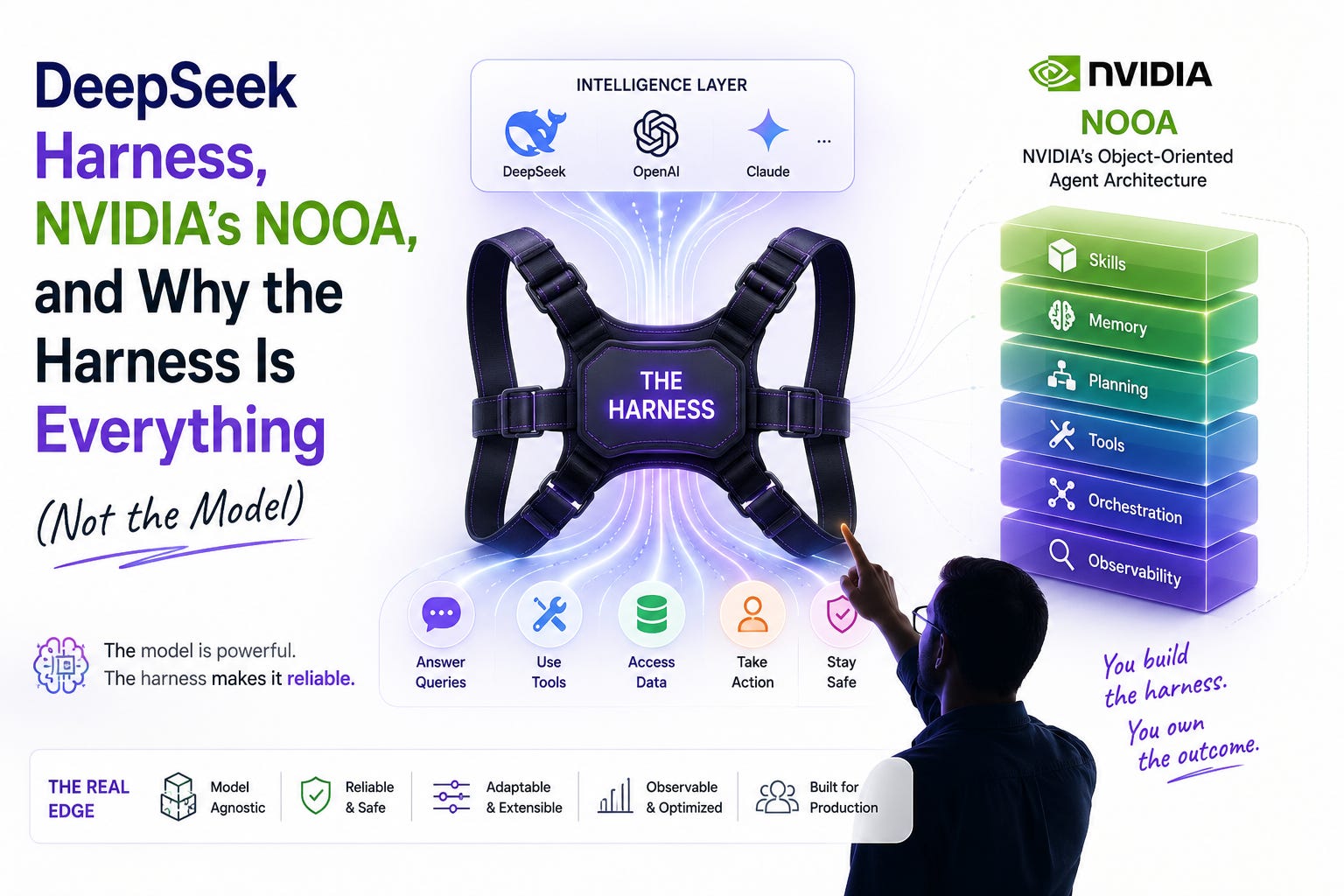
The harness - the loop, the tool-calling contract, the memory, the guardrails around the model is what separates something that works from something that hallucinates, loops, or quietly does the wrong thing.
This week gave us a perfect case study.
DeepSeek's biggest launch of the week wasn't the model
On August 13, DeepSeek shipped DeepSeek Harness v0.1, a developer preview, MIT-licensed, open-sourced the same day as its DeepSeek-V4-Pro model GA release.
Repo: https://github.com/deepseek-ai/deepseek-harness
What’s notable is what they chose to open source alongside a flagship model launch: not another benchmark flex, but the scaffolding.
The core idea is “everything is a plugin” the inference layer, tool registry, session state, control loop, execution sandbox, even the web UI are all separately swappable pieces, built on what they call the Cordis meta-framework.
It’s DeepSeek’s answer to Claude Code: not a smarter model wrapped in a fixed harness, but a harness you can rebuild around any model.
The repo hit 100K+ GitHub stars and 11K+ forks within 3 days — one of the fastest adoption curves a dev tool has seen this year.


What people are saying about it specifically:


Within 24 hours - the OSS community contributed 365 plugins


Here’s what the creator of another famous harness “Pi” has to say

DeepSeek clearly read the room — they didn’t just ship a better model, they shipped the thing that lets any model perform better.
Why I went down the NVIDIA object-oriented agents rabbit hole
This is exactly why I spent this week digging into NVIDIA’s NOOA (NVIDIA Object-oriented Agents) because it’s one of the more radical harness redesigns I’ve seen, and it’s not just theory.
NVIDIA’s own benchmarks show NOOA agents solving more problems on SWE-bench while using roughly half the tokens - same underlying model, no prompt compression tricks.
The core idea: stop inventing a new agent language.
Your agent is just a Python class. Methods become tools, docstrings become instructions, type hints become runtime-enforced rules and you can leave a method body as just “..." and the framework writes and executes the implementation for you at runtime.
Three design choices do the heavy lifting:
Code as the action — instead of the model emitting JSON that gets parsed into a function call every single turn, the model just writes Python directly. No parse/translate loop repeating on every tool call.
Pass by reference — instead of serializing a whole object (think: an entire spreadsheet) into the prompt as text, NOA hands the model a reference to the actual object and lets generated code operate on it. The prompt only carries a tiny preview.
Typed I/O as guardrails — Pydantic-style validation gets enforced automatically, and the agent self-corrects against validation errors without you writing retry logic.
In a live demo, a naive tool-calling loop burned 10,823 tokens across 10 LLM calls to check whether a shopping cart fit a budget; NOOA did the same task in 2 calls and ~7,194 tokens — a ~33% reduction, in line with NVIDIA’s own published numbers.
It’s still early — NVIDIA is upfront that this is research-stage, and letting a model generate and execute arbitrary code means you sandbox it, full stop, never run it against your primary filesystem. But as a glimpse of where harness design is heading — away from JSON tool-calling ceremony and toward “the agent is just... code” — it’s the most interesting thing I’ve read this month.
🎥 Full walkthrough with live demos:
The thread connecting both stories this week: nobody’s winning by having the smartest model anymore.
DeepSeek and NVIDIA, in completely different ways, are both racing to build the best scaffolding around models that are all converging toward “good enough.”
That’s where the real engineering work and the real differentiation is happening now.
Build AI Agents by Building a Real Project
Most LangChain tutorials teach APIs.
This one teaches AI engineering.
In this new video, we build Aria, an AI Executive Assistant, while learning LangChain the way production systems are actually built—one capability at a time.
You’ll hand-code tools, memory, agents, MCP, and more, so you don’t just know how to use AI agents—you understand how they work and how to debug them.
If you’re serious about becoming an AI Engineer, this is the series to follow.
🎥 Watch the video and start building Aria today.