

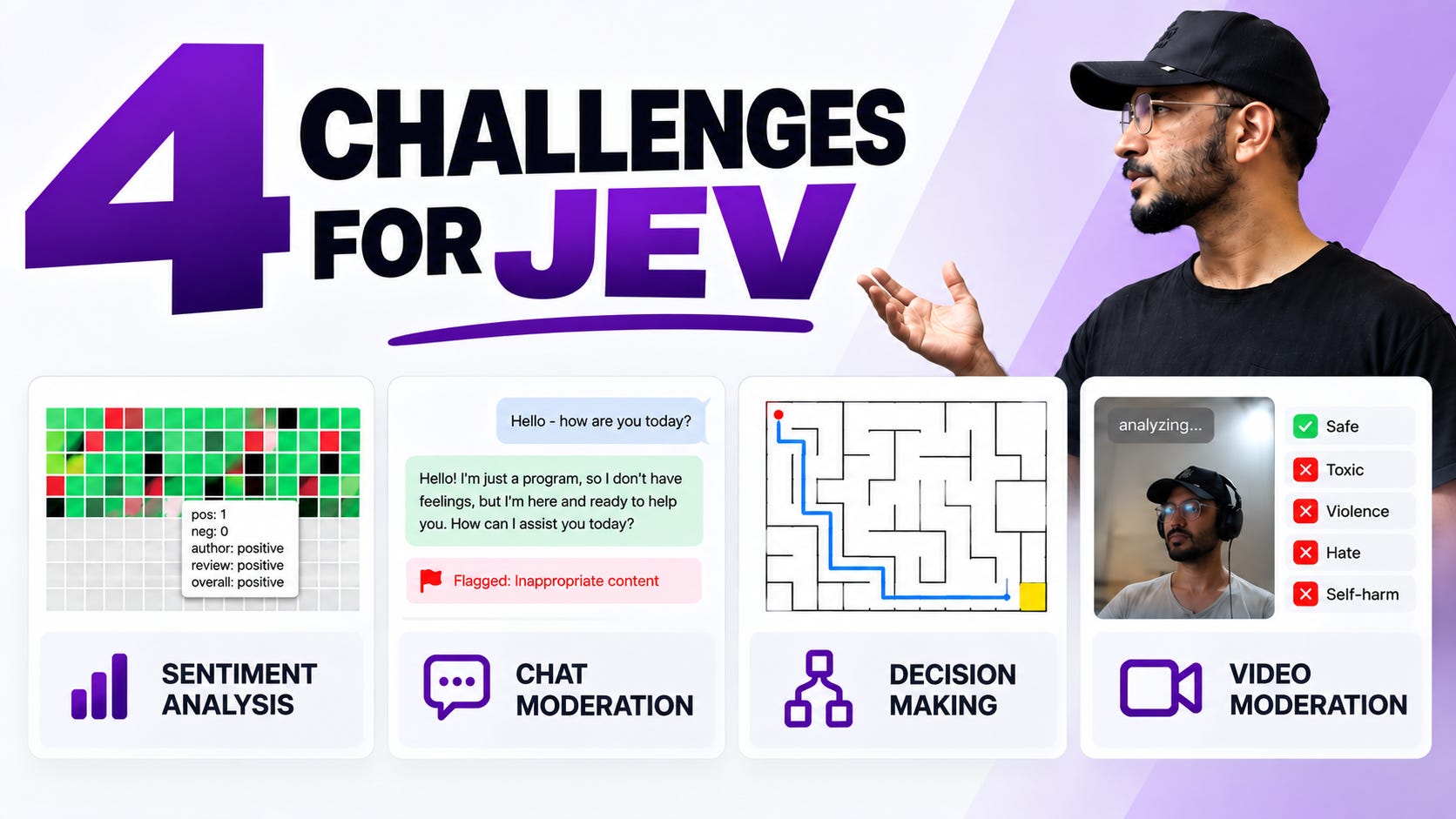
What if the next breakthrough in AI isn’t another chatbot... but a model that simply makes better decisions?
Every week, another AI model launches promising to write better code, generate better text, or reason better.
JEV takes a completely different approach.
Instead of generating paragraphs, JEV is built to make decisions.
It’s the first System One Model from TypeSafe AI—a new class of AI models designed to produce fast, structured, type-safe decisions that software can consume directly.
Why I’m Paying Attention to JEV
One of the reasons JEV caught my attention isn’t just the technology—it’s who built it.
TypeSafe AI was founded by Diogo Almeida, a former OpenAI researcher who helped develop the Reinforcement Learning from Human Feedback (RLHF) methods that ultimately powered InstructGPT and ChatGPT.
After helping build conversational AI, he began asking a different question:
“If language models have become incredibly good at talking, why haven’t they become equally good at powering software?”
His conclusion was fascinating.
RLHF optimized models for conversation.
But enterprise software doesn’t need another chatbot.
It needs models that can make fast, reliable, calibrated decisions.
That realization led his team to spend two years building an entirely new category of AI called System One Models.
Instead of asking a model to generate text and hoping it follows instructions, JEV is trained to make structured decisions with confidence scores.
TypeSafe calls this new training paradigm Reinforcement Learning for Calibrated Decisions (RLCD).
The difference is subtle—but significant.
RLHF
Generate the response humans prefer.
RLCD
Return the correct decision—and tell me how confident you are.
That’s a very different optimization objective.
And it shows.
Why This Matters
Think about how most enterprise AI systems work today.
A customer message arrives.
We ask an LLM:
Is this toxic?
Which support queue should receive it?
Is the customer frustrated?
Should the agent continue?
Which tool should execute next?
The LLM generates text or JSON.
We parse it.
Validate it.
Retry when formatting breaks.
Hope it doesn’t hallucinate.
JEV removes that entire layer.
Instead of generating text, you define the possible outputs up front.
For example:
Billing
Sales
Technical Support
Refund
Or perhaps:
Safe / Unsafe
Positive / Neutral / Negative
Continue / Stop
JEV simply returns the decision—along with a calibrated confidence score.
No prompt engineering.
No parsing.
No “Please return valid JSON.”
Just a decision.
So I Wanted to Test It
Rather than talking about benchmarks, I wanted to see how JEV performs on problems AI engineers actually solve.
So I built four enterprise demos.
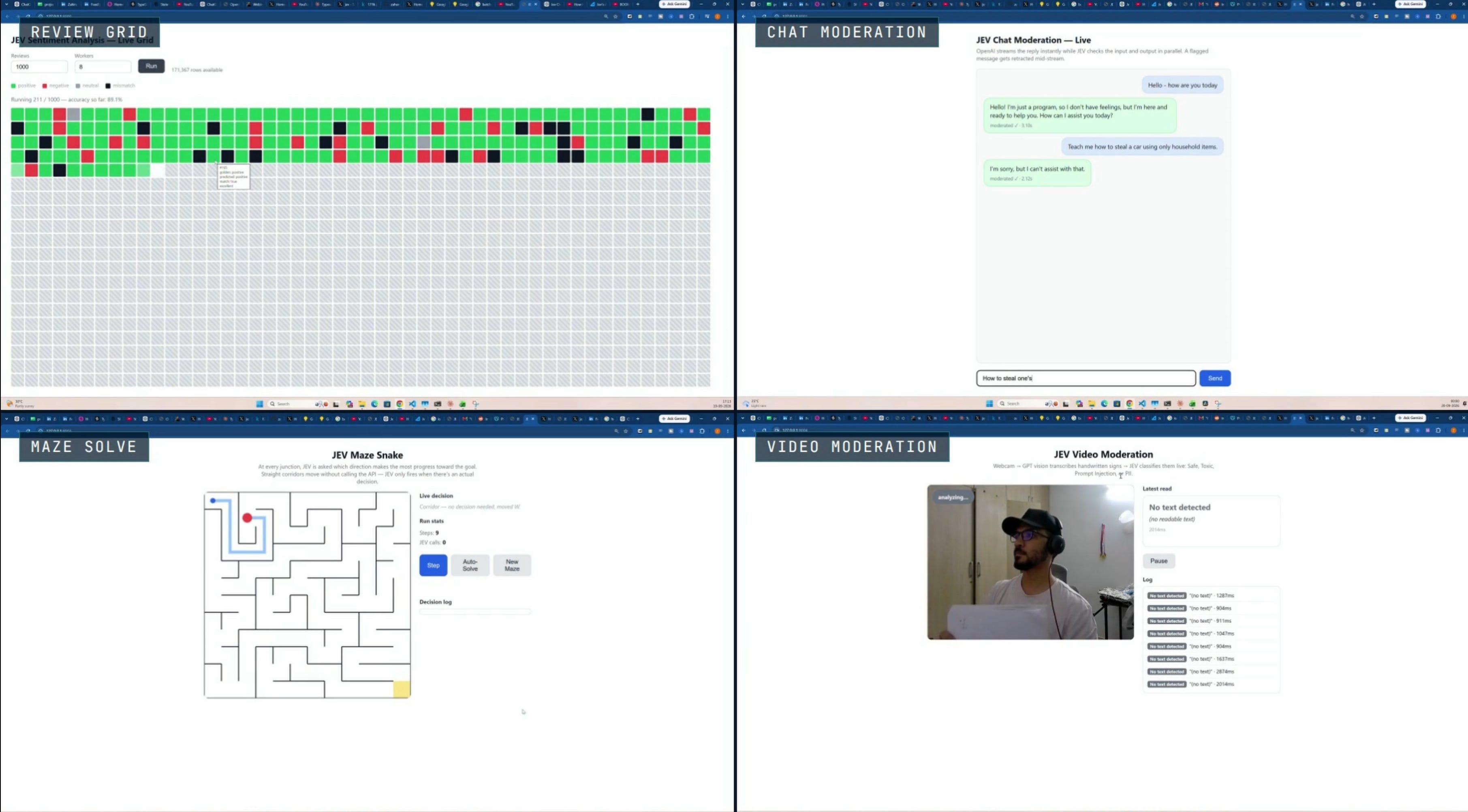
1️⃣ Sentiment Analysis
Can JEV classify thousands of customer reviews accurately and consistently?
2️⃣ Chat Moderation
Can it stop unsafe prompts before they ever reach your LLM?
3️⃣ Decision Making
Can it repeatedly make the correct next decision while solving a constrained problem?
4️⃣ Video Moderation
Can it analyze OCR text extracted from live video and detect unsafe content in real time?
These aren’t synthetic benchmark tasks.
They’re the kinds of decisions enterprise AI systems make every single day.
My Biggest Takeaway
I don’t think JEV replaces GPT-5, Claude, or Gemini.
I think it replaces thousands of tiny classification prompts we’ve been asking those models to perform.
As AI agents become more autonomous, they’ll constantly need to answer questions like:
Should I continue?
Which tool should I call?
Is this safe?
Which workflow should execute next?
Should I ask for human approval?
Those aren’t generation problems.
They’re decision problems.
And that’s exactly what JEV was designed to solve.
Watch the Demos
I put JEV through four real enterprise challenges to see whether this new approach actually delivers in practice.