

I didn’t realize I was doing Forward Deployed Engineering until someone else gave it a name.
Like many engineers, I associated it with companies like OpenAI, Anthropic, or Palantir.
Engineers who work directly with customers, helping them solve complex technical problems and deploy AI into production.
Then it hit me.
I’ve been doing a version of this for over a year now.
Not for external customers.
For internal ones.
And I think this is one of the most exciting AI career paths that almost nobody is talking about.
My customers aren’t outside the company.
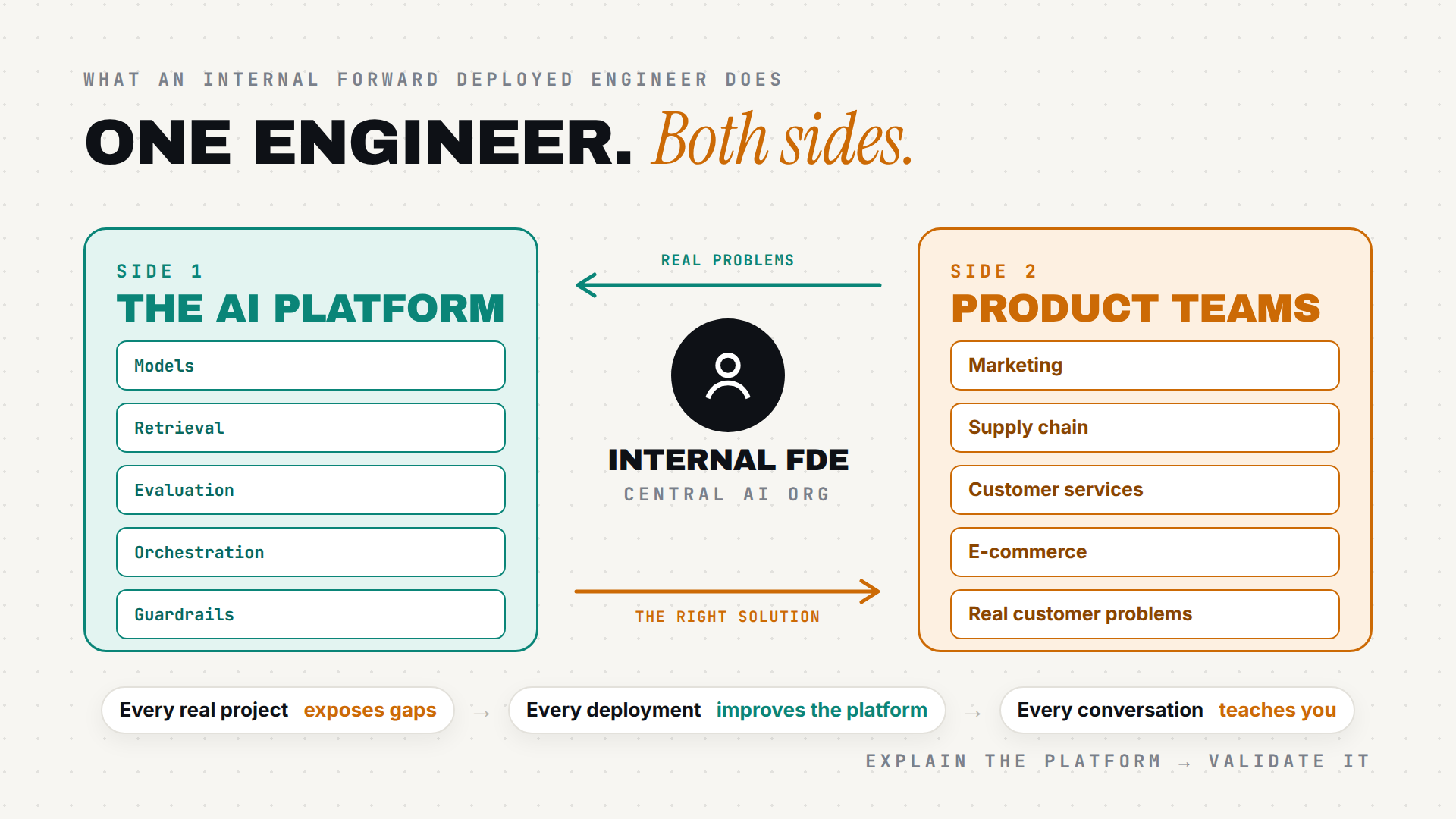
They’re inside it.
I work in a central AI organization.
Across the company, different teams are trying to build AI.
Marketing
Supply Chain
Customer Services
IT
E-commerce
Every team has different goals.
Every team has different data.
Every team has different constraints.
But they’re all trying to build on the same AI platform.
My job isn’t to build every AI solution.
It’s to help teams build the right one.
Sometimes that means helping design an agent architecture.
Sometimes it’s deciding between RAG and fine-tuning.
Sometimes it’s defining evaluation metrics before anyone writes a line of code.
Sometimes it’s debugging why an AI agent works perfectly in a demo—but fails in production.
The technology changes every week.
The real job doesn’t.
Bridge AI capability with business value.
Why companies need this role
Every large company eventually faces the same problem.
One team builds the AI platform.
Everyone else tries to use it.
In theory, that’s incredibly efficient.
In reality, application teams quickly discover problems the platform team never anticipated.
So they create workarounds.
They duplicate code.
They build custom orchestration.
They invent new evaluation methods.
Eventually, every team starts solving the same problems independently.
That’s expensive.
And it’s slow.
Companies need engineers who can move between both worlds.
People who understand the platform deeply...
but spend enough time with product teams to understand real business problems.
Every customer conversation becomes feedback for the platform.
Every production deployment improves the platform.
That’s what makes this role so valuable.
How do you become one?
If this sounds like a role you’d enjoy, here are the five things I’d focus on.
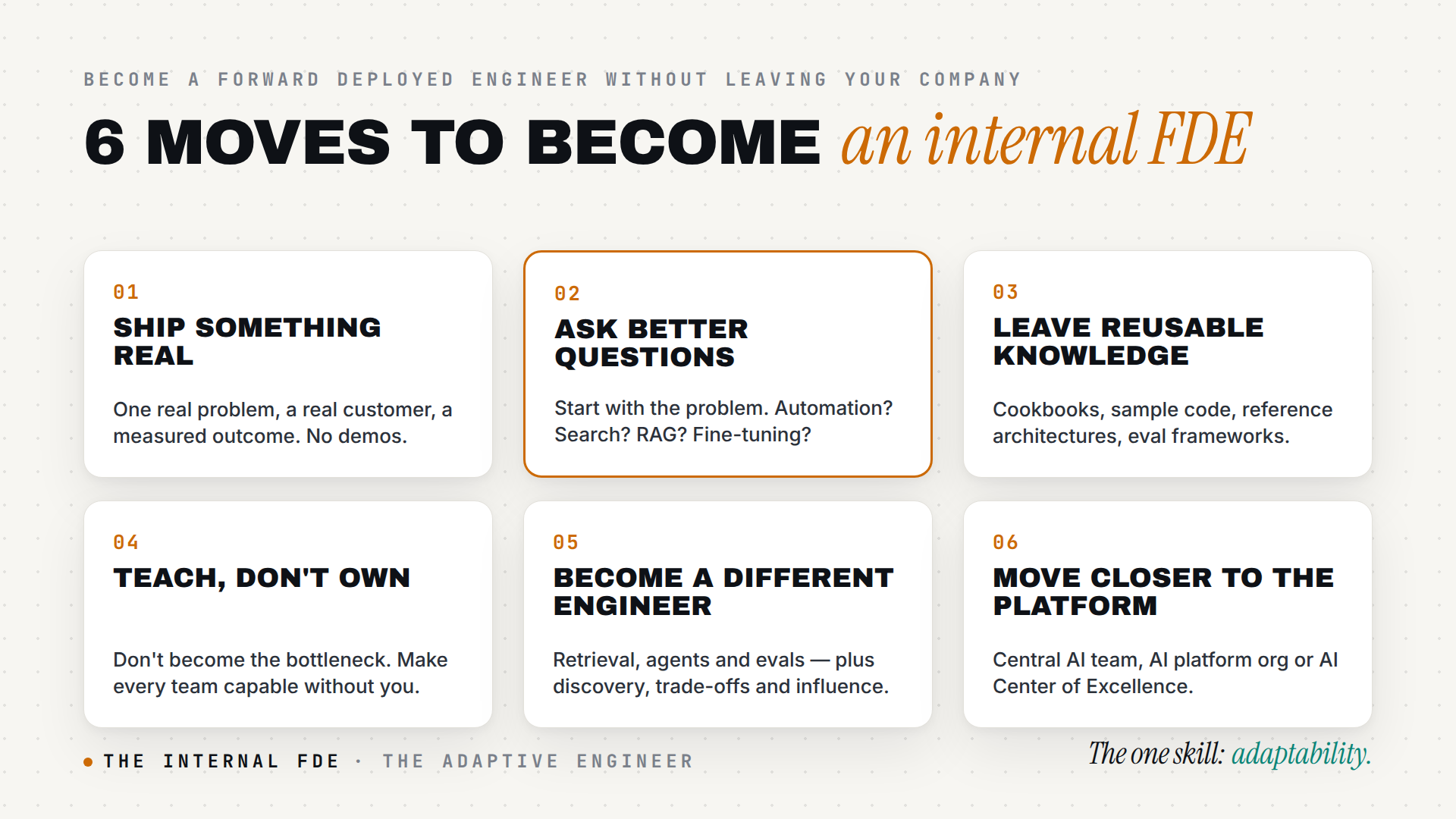
1. Ship something real.
Don’t build demos.
Solve a real business problem.
Have real users.
Measure the outcome.
Nothing builds credibility faster than software people actually depend on.
2. Learn to ask better questions.
When someone says:
“We need an AI agent.”
Pause.
Ask why.
Could automation solve it?
Could search solve it?
Would RAG work?
Do we really need fine-tuning?
Great AI engineers don’t start with models.
They start with the problem.
3. Leave behind reusable knowledge.
When you help another team...
Don’t just solve today’s issue.
Leave behind:
a reference architecture
a cookbook
sample code
evaluation criteria
Your impact grows when the next team can solve similar problems without needing you.
4. Teach instead of owning.
One trap I’ve seen repeatedly is becoming the AI person.
Every project comes through you.
Every deployment depends on you.
Every prompt gets reviewed by you.
Congratulations.
You’ve become the bottleneck.
The goal isn’t to own AI.
The goal is to make everyone around you better at building it.
5. Become a different kind of engineer.
This is probably the biggest lesson I’ve learned.
The technical skills are obvious.
You’ll work on:
Agent architectures
Retrieval systems
Model selection
Tool integration
Evaluations
Production debugging
Observability
AI platform design
But the soft skills are what really change your career.
You learn how to:
Run discovery sessions.
Communicate with non-technical stakeholders.
Influence teams that don’t report to you.
Present trade-offs instead of opinions.
Build trust with customers.
Manage expectations.
Explain complex AI systems to executives.
Those skills are difficult to learn if you spend your entire career inside one product team.
An internal FDE develops both.
You become a stronger engineer.
And a stronger business leader.
Why I think this role matters
People often ask me:
“What’s the most important skill to learn in the AI era?”
They expect me to say:
AI Agents
MCP
LangGraph
Fine-tuning
Those are all important.
But my answer is different.
Adaptability.
Every customer is different.
Every business problem is different.
Every deployment teaches you something new.
That’s what this role forces you to become.
Not someone who knows every AI framework.
Someone who can apply AI to almost any business problem.
And I believe that’s going to be one of the most valuable engineering skills of the next decade.
Final thought
If you’re already the person people come to when they’re trying to build AI...
If you’ve helped multiple teams adopt AI inside your organization...
If you’ve spent as much time understanding business problems as writing code...
You might already be doing this job.
You just haven’t given it a name yet.