

I didn’t write my first real line of code until my early 30s
Before that, I was a journalist. Then I moved into operations. And for years, one thought sat at the back of my mind that I never said out loud:
I want to build things.
Today, I’m an architect. I design AI agent systems for a living.
That’s why one claim from Big Tech stopped me cold.
🎥 Watch: Could AI Predict My Career?
The race for your personal agent
Three of the biggest tech companies in the world are racing to build the AI that runs your life:
→ xAI’s Grok Bot runs on its own cloud computer and learns a task by watching you do it once.
→ Meta’s Muse hit #1 on the App Store within a week by cutting bills and chasing refunds.
→ OpenAI’s Dots is OpenAI’s own play for the same job.
Meta’s Chief AI Officer, Alexandr Wang, goes furthest. In his essay Why We’re Building Muse, he describes an AI that works like a “second mind.” It figures out what you want, then makes it happen.
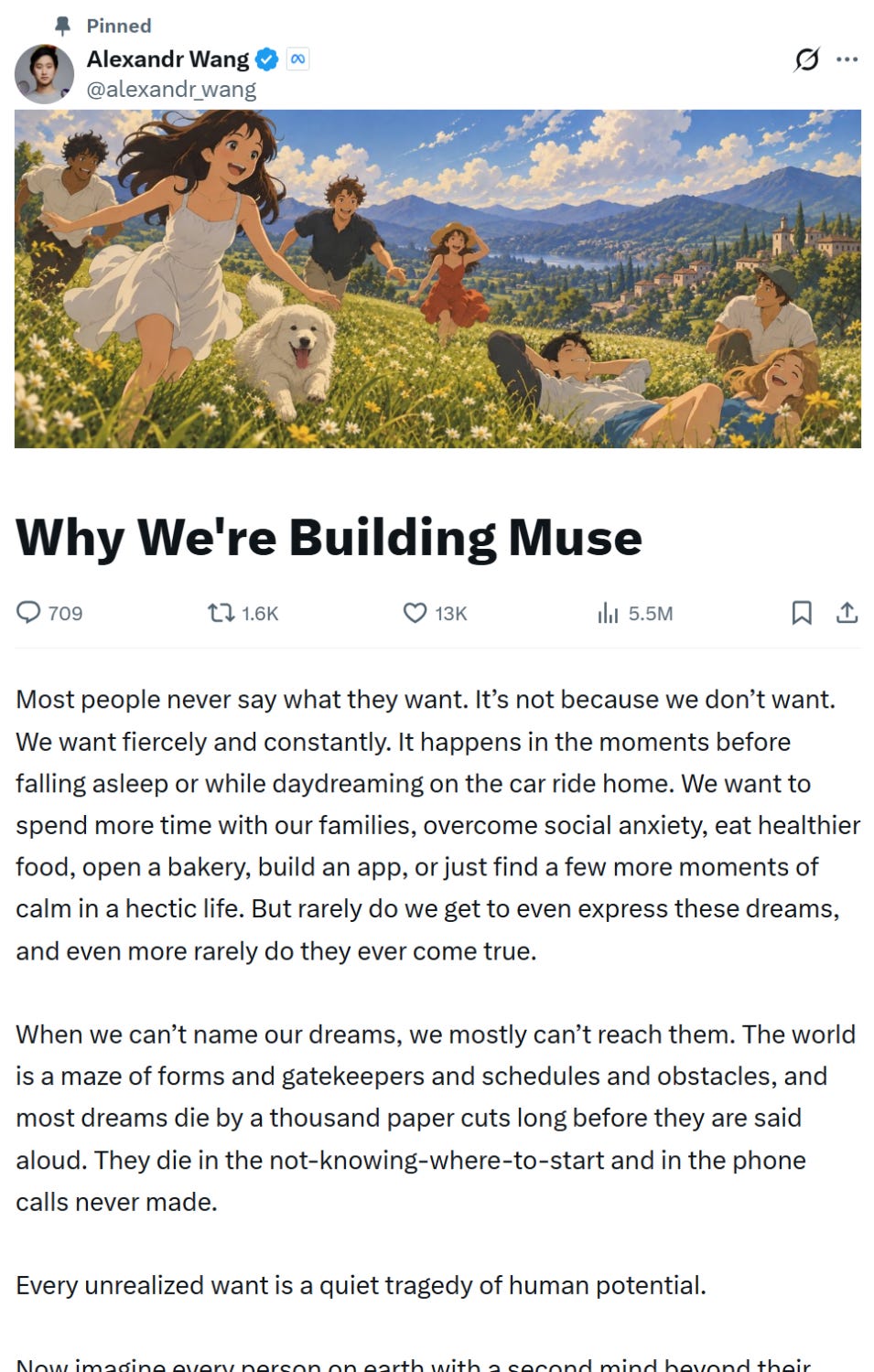
His line: “Every unrealized want is a quiet tragedy of human potential.”
It’s a beautiful idea. I don’t think it could have worked for me.
Where Wang is right
Dreams rarely die in one big failure. They die from a thousand paper cuts: the form you keep postponing, the email you never send, the call you push to tomorrow.
An agent that clears those is genuinely useful. That’s especially true for people without time, money or a mentor.
But his essay makes two different promises and blends them together.
The intent ladder
Here’s the simplest way I know to see the gap. There are three levels of what you can ask an AI:
Level 1: “Do this.” Cancel my unused subscriptions. The goal is clear and the result can be checked.
Level 2: “Help me with this.” Help me save money. It takes several steps, but you can still measure it.
Level 3: “Figure out what I want.” “I feel like there’s something more I could be doing.”
Wang’s essay is about Level 3.
Now look at what Muse is actually being sold for: cable bills, insurance, refunds. Level 1 and Level 2.
The essay talks about dreams. The product handles bills.
Why Level 3 is so hard
It isn’t a marketing gap. It’s a technical one, and there are three reasons.
I break all three down in the video. One of them is personal.
Imagine an AI had read everything about me in my early thirties: my articles, my emails, my searches. I tell it I want something different.
It would have suggested senior editor. Content strategy. A communications job at a tech company.
It would never have said “learn to code at 35 and become an architect.” Nothing in my data pointed there.
AI guesses who you were. Not who you could become.