

AI Agents = Model + Harness
Watch the full walkthrough:
For a long time, AI discussions revolved around one thing: the model.
GPTs. Claudes. Geminis, etc.
But if you’ve built even a single production-grade agent, you’ve probably realized something:
The model is only one part of the system.
Today, a much better definition is emerging:
Agent = Model + Harness
The model provides intelligence.
The harness makes that intelligence reliable.
And that’s where most of the engineering happens.
What is Harness Engineering?
Harness Engineering is the software architecture surrounding an LLM that transforms it into a production-ready autonomous system.
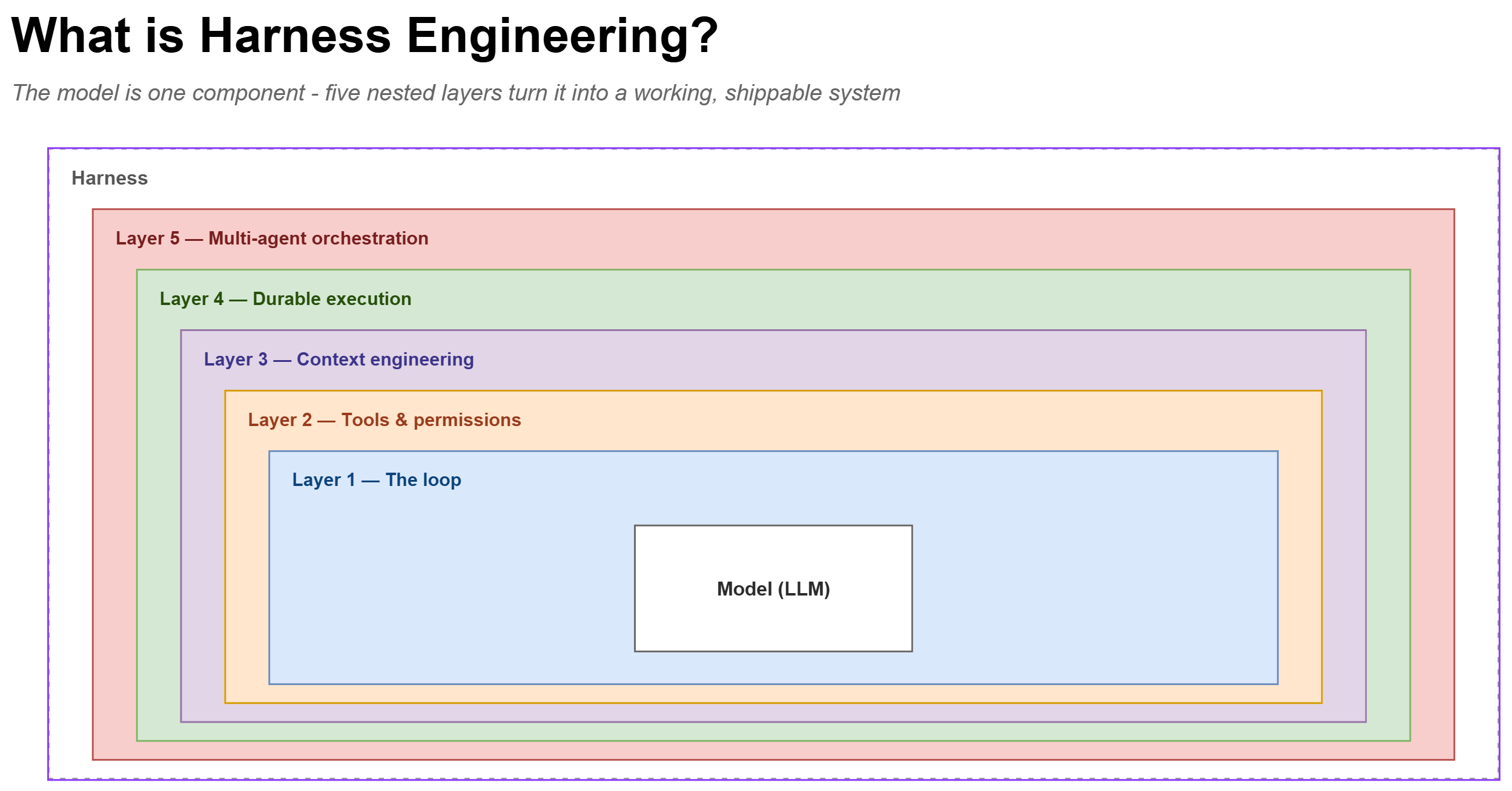
Think about everything that exists outside the model:
Prompts
Tool calling
Feedback loops
Memory
Context management
Human approval
Guardrails
Multi-agent orchestration
All of these components work together to create an agent that can reason, act, recover, and complete tasks reliably.
The harness is what connects all these pieces.
Layer 1: The Loop
I begin with what I believe is the most fundamental layer:
The Loop.
Its responsibilities are surprisingly simple:
Call the model.
Evaluate the response.
If the task isn’t finished, call the model again.
Repeat until the goal is complete.
Without a loop, an LLM performs exactly one inference:
Input → Output
That’s useful for chat.
It isn’t enough for autonomous agents.
The Anatomy of One Iteration
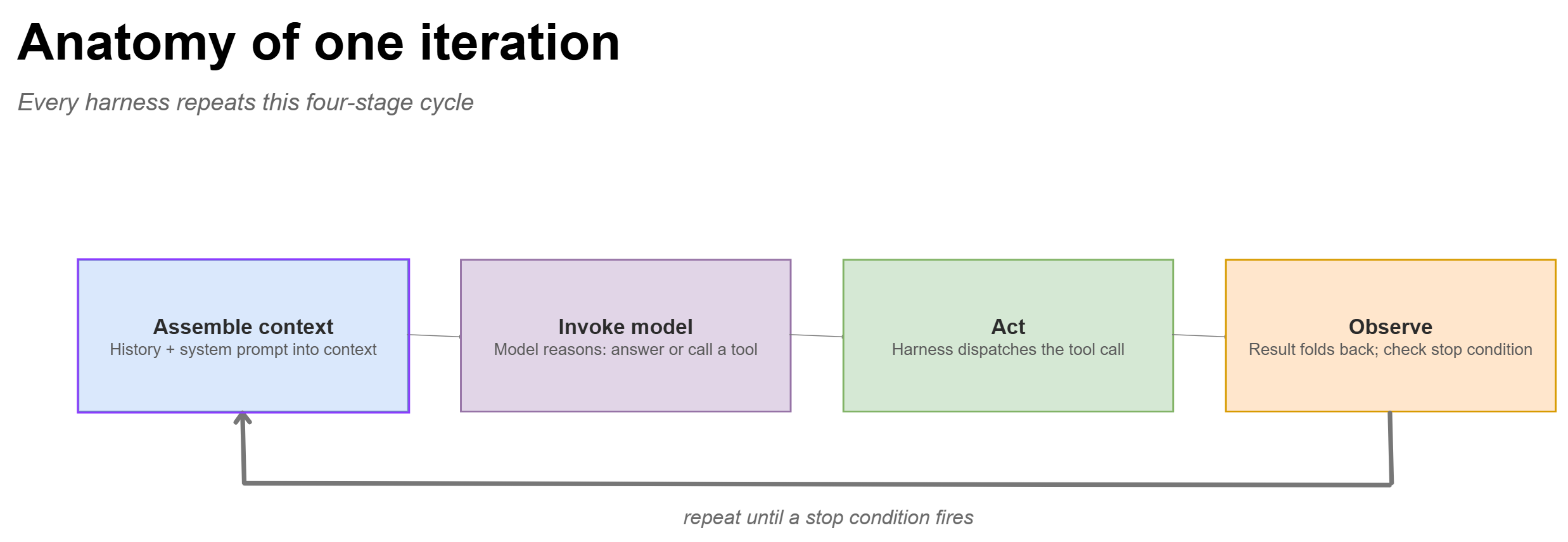
Every iteration of an agent loop follows the same fundamental lifecycle.
1. Assemble Context
Before the model is called, the harness gathers everything the model needs:
User request
Conversation history
Previous tool results
System prompt
Available tools
This becomes the complete context for the next decision.
2. Invoke the Model
The harness sends the assembled context to the LLM.
At this point, the model has only two real choices:
Return a final answer.
Request one or more tool calls.
Nothing else.
3. Observe the Response
The harness inspects the model’s output.
If the response contains a tool call, it extracts:
Tool name
Arguments
Metadata
If it’s a normal response, it may already be time to terminate the loop.
4. Execute the Tool
If the model requested a tool, the harness—not the model—executes it.
This could involve:
Querying a database
Calling an API
Running code
Searching the web
Reading files
The model never executes tools directly.
It only decides which tool should run.
5. Update the Context
The tool result isn’t immediately returned to the user.
Instead, the harness appends it to the conversation history.
Now the model knows:
“I asked for this information, and here’s what I received.”
This allows the model to continue reasoning using fresh information.
6. Decide Whether to Continue
Finally, the harness determines whether another iteration is needed.
If the model has everything it needs, it responds to the user.
Otherwise, the loop repeats.
Every Major Agent Uses the Same Pattern
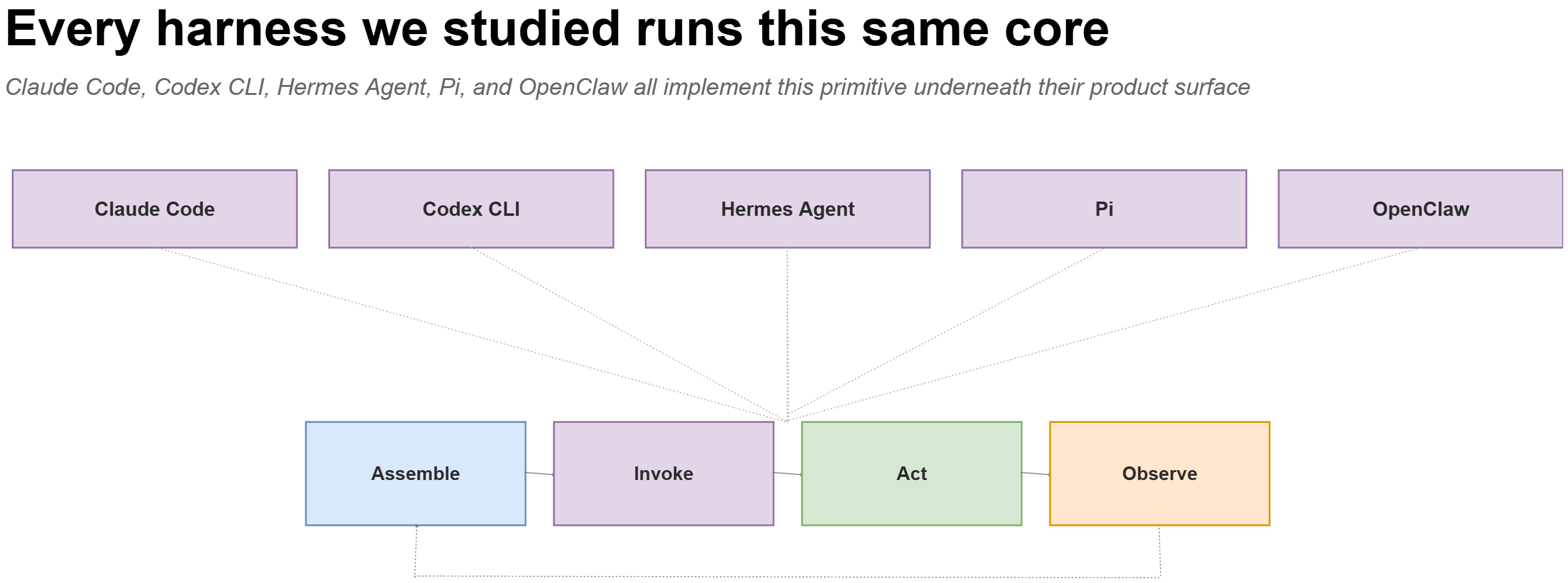
Whether it’s:
Claude Code
Codex CLI
Hermes
OpenClaw
OpenAI Agents
...they all implement essentially the same loop.
The details differ.
The architecture doesn’t.
At a high level, every loop looks like this:
Assemble context.
Call the model.
Check whether it wants to use a tool.
Execute the tool if needed.
Add the result back into context.
Repeat until a stopping condition is reached.
Once you understand this pattern, reading agent frameworks becomes dramatically easier.
Production Loops Need Guardrails
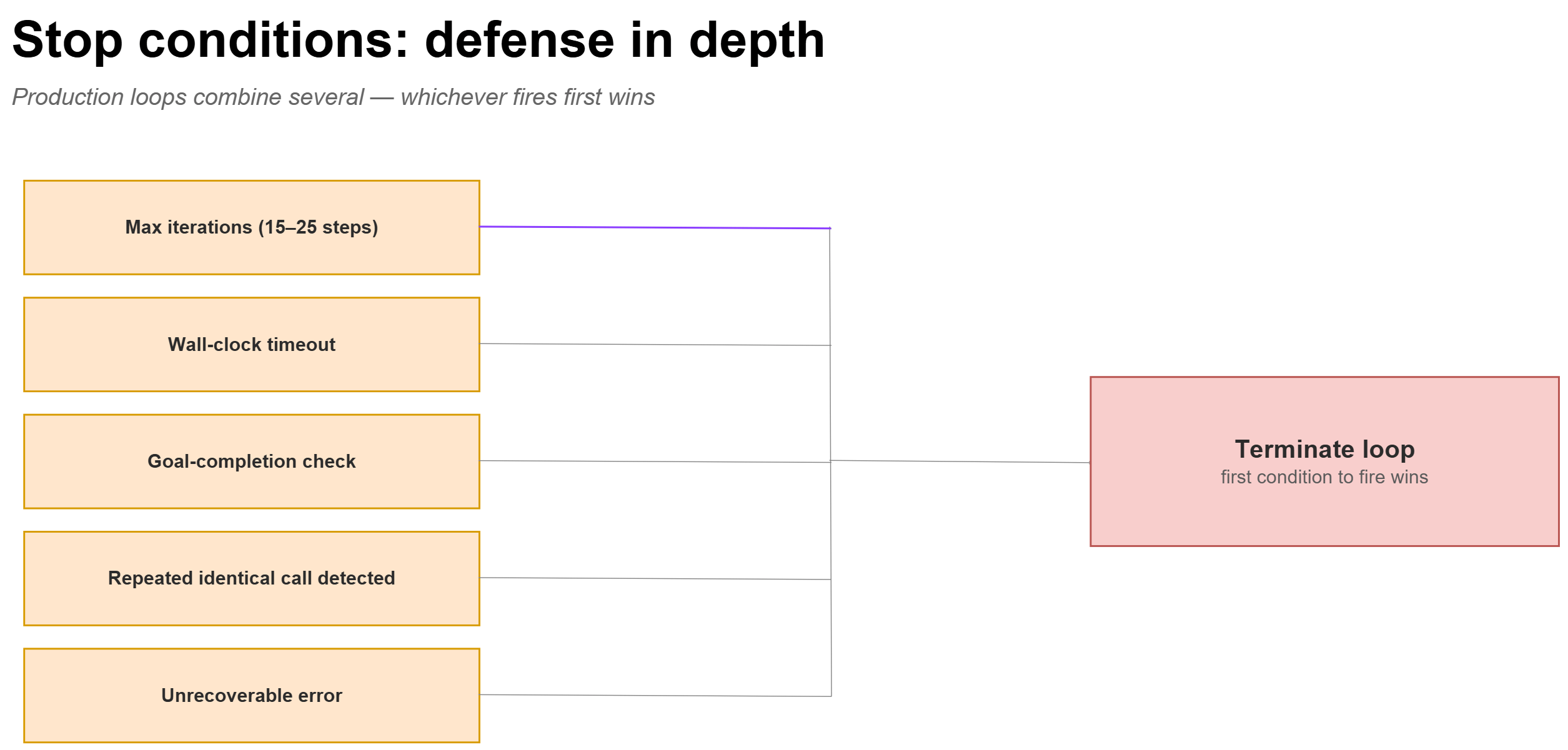
A production loop can’t simply run forever.
Reliable systems need explicit termination conditions.
Some of the most important ones include:
Maximum iteration limits
Wall-clock timeouts
Goal completion checks
Repeated tool-call detection
Handling unrecoverable errors
Token budget limits
These aren’t optional.
They’re what prevent runaway loops, excessive API costs, and unreliable agent behavior.
The Loop Leaves Behind State
When a loop finishes, it doesn’t just return an answer.
It also leaves behind valuable execution state:
Tool history
Context
Intermediate reasoning
Progress
Execution checkpoints
That state becomes the foundation for durable execution, resumable agents, and human-in-the-loop workflows.
In other words:
A good loop doesn’t just solve problems.
It creates the foundation for every layer that comes after it.
The Bigger Picture
This article is the first in a series on Harness Engineering.
We’ll progressively build the software architecture that surrounds modern LLMs:
Layer 1 — Loops ✅
Layer 2 — Tools & Permissions
Layer 3 — Context Engineering
Layer 4 — Durable Execution
Layer 5 — Multi-Agent Orchestration
By the end of the series, you’ll understand not just how to use agent frameworks—but why they’re built the way they are.
If you’re serious about building production-grade AI agents, understanding the harness may be even more valuable than understanding the model itself.